Is there a decimal computing PC?
Hello dear community of good questions.
I recently came across a way to route decimal values back and forth in Minecraft on a cable. The whole is modular, so that you can send any value.
With this technique, I now plan to build a simple computing unit and a circuit that transmits letters. But since this happens in decimal, I don't really know how to convert letters to decimal values, and back again.
Therefore, I would like an example from real computer science, i.e. A PC that does not calculate binary, but, however, decimal. Is there such a thing? If so, a link would be super nice
The whole is modular, so that you can send any value.
I hardly believe that.
Please transfer PI.
In theory, you can build such a PC, but in practice it is rather unfavorable, since you have to differentiate between ten different voltages and this leads to problems much faster. So making something like that is pretty nonsense.
A PC always calculates in binary. A computer always consists of switching units - these can be activated or not activated. So two states -> binary.
Do not know to what extent you can now do this in MC, but in principle you could code the letters. If you only want to pass letters you need a binary number up to 5 digits, you also want to pass numbers or other characters, then 6 digits.
The principle is simple A = 0 B = 1 C = 10 D = 11 E = 100 F = 101 G = 110 H = 111 I = 1000 etc.
By any size I mean e.g. 50 digits (It would take a long time, but it would work)
Not that you have any number of decimal places.
Of course, that doesn't go on forever
All calculations within a digital computer, such as one, must ultimately be traced back to the binary system with zeros and ones (also called a dual system). Of course, all numbers in every other system (decimal, octal, hexadecimal) have corresponding values, so that they can be represented by software in the respective desired system.
A decimal computer might initially be easier to understand, but technically hardly feasible, since the underlying material would have to have 10 different states.
We're talking about Minecraft. The transfer of decimal numbers already exists.
Your solution to solve it in the decimal system is to use binary?
aha ^^
A computer always consists of switching units - these can be activated or not activated. So two states -> binary.
And what about analog computers? 😉
As far as I know, there was no such thing as a "real" decimal computing digital (discrete) computer. In the early days of computers, a lot was still done with BCD code (and similar codes), i.e. Each digit in the 10-digit system was saved individually with 4 bits… You also experimented with ternary computers, i.e. The processing of 3 states - that would actually be the optimum for efficient storage space.
There are e.g. Mechanical cash registers that could add up with a system of 10 and of course analog electronic computers, but which work on a completely different principle.
Apart from that, it shouldn't be that difficult to transfer a simple CPU to the decimal system. Whether 64 bit wide binary number or decimal number makes little difference.
You can simply find a code for letters, for example:
A = 01, B = 02, C = 03, D = 04, … K = 11, Z = 26
But these are not computers - computers are digital computers.
My answer goes to the specific question:
"Is there a decimal computing PC?"
and is "an example from real computer science";)
Of course, coding also works with decimal numbers…
So: A = 0 B = 1 C = 2 D = 3 E = 4 F = 5 G = 6 H = 7 I = 8 J = 9 K = 10 L = 11 etc.
Ultimately, it's just about the basic logic of computer science. Codings can be transferred to decimal, hexadecimal etc.
But by definition not.
The first "computers" were people. Funny, is not it?
According to DIN standard 44.300, IT in computer science is generally understood to mean computer "program-controlled, memory-programmed digital computing system".
Well, if a norm says that.
Then the human computer probably did not exist because Germans sat down and defined it that way.
Supi
greeting
edit: The Germans are technologically the measure of all things anyway. Everyone knows that they are far ahead.
But these are not computers - computers are digital computers.
No.
See u.a. Here:
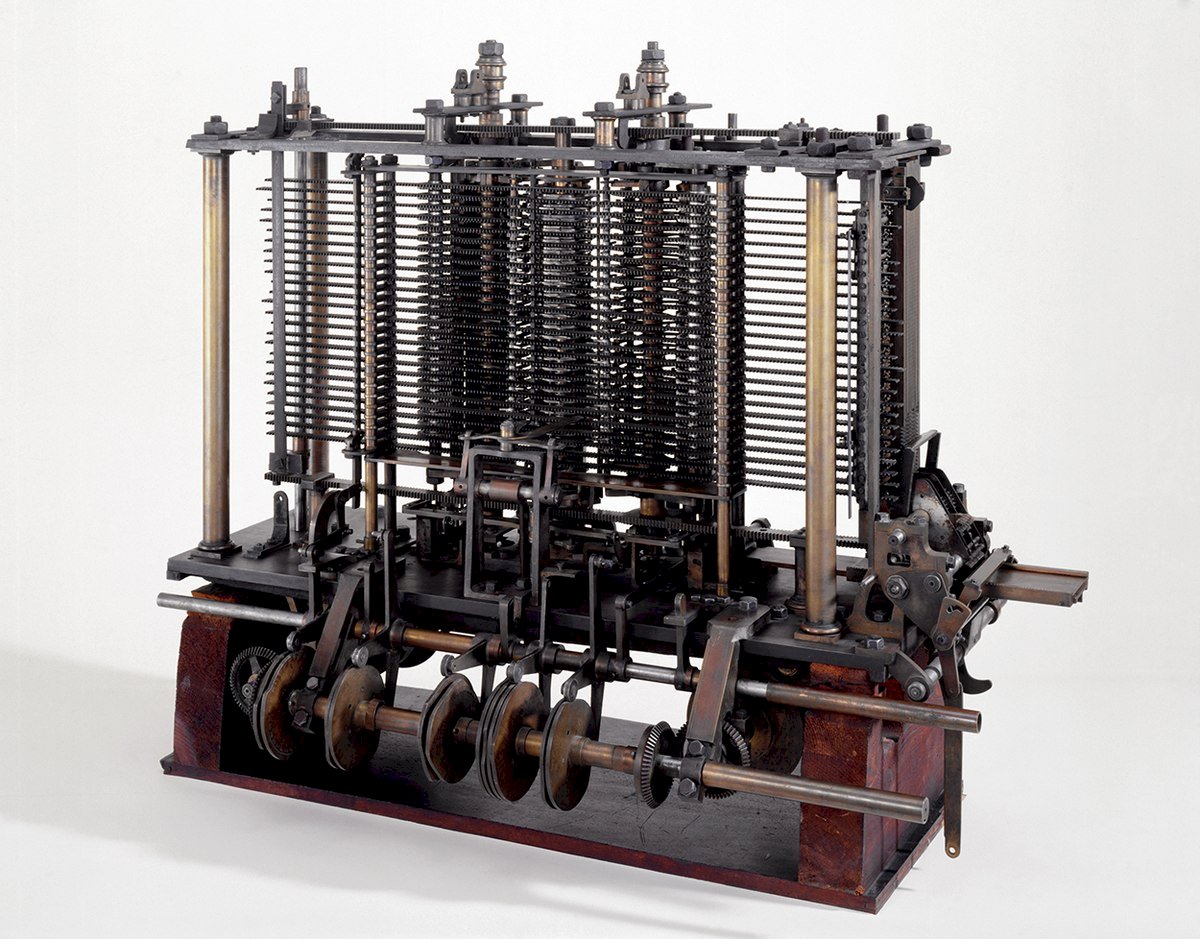
https://de.wikipedia.org/...Grundlagen
Literature from the last millennium that deals with this topic is still somewhere in the bookcases.
Well, when it came to standardization, Germany was the leader. The digital computers are ne German invention. And in terms of general know-how, Germany is still in a good position. Unfortunately, more and more companies are going to foreign companies: /
Where it lags in Germany in terms of digitization.
The human "computer" is usually called the brain, although that seems to be deteriorating more and more when you see people who can't even calculate single-digit decimal numbers in their heads ^^
Actually, it was clear long before, but when Merkel spoke of "new territory", it was clear to the last one.
But I don't want to have that.
In computer science, according to DIN standard 44.300, computers are to be understood as "program-controlled, memory-programmed digital computing systems".
Well, it's not a hat, it's more a fact. If you look at the slow broadband expansion… It has been missed since the beginning (as early as the 90s), the privatization of Telekom, which has been so praised, has proven to be a big mistake. Now you are 10 years behind the other countries…: /
And then wonders why living space is becoming scarce in certain metropolises and why companies and job seekers avoid the country…
In computer science, according to DIN standard 44.300, computers are to be understood as "program-controlled, memory-programmed digital computing systems".
When this German standard came into force, analog computers were quite exotic, the spread of which was minimal. Therefore, the standard should refer to the digital. 😉
Computers, calculators, electron brains, computers, all previously common terms.